
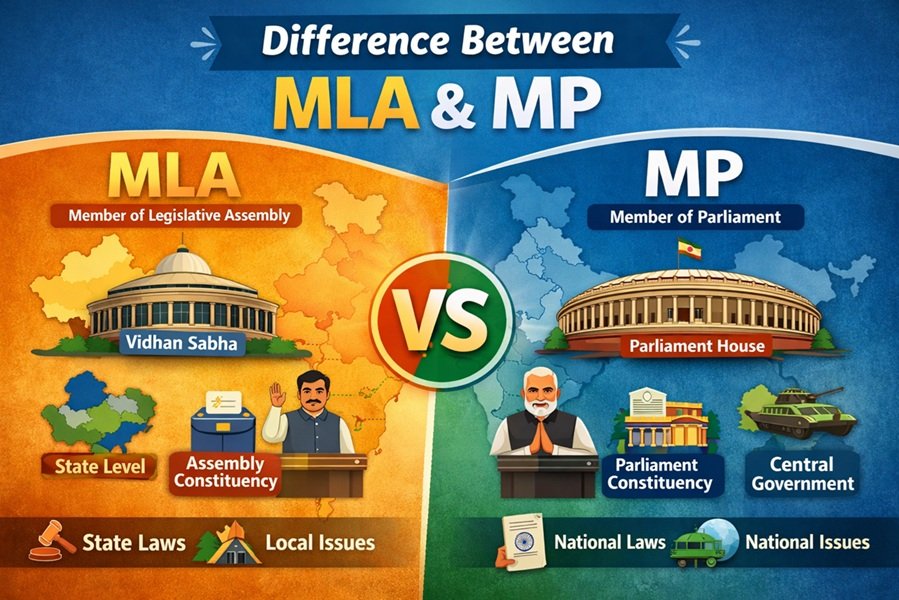
Difference Between MLA and MP in India
In the Indian democratic system, the terms MLA (Member of Legislative Assembly) and MP (Member of Parliament) are very common. Both are elected representatives of the people, yet their roles, responsibilities, and areas of functioning are quite different. Understanding the distinction between an MLA and an MP is essential for every Indian citizen, as it helps in knowing whom to approach for different public issues.
This article explains in depth the key differences between MLA and MP in India.
Introduction to MLA and MP
India follows a federal structure of governance. This means there are governments at two major levels:
- State Level Government
- Central Level Government
- An MLA represents people at the state level.
- An MP represents people at the national (central) level.
Though both work for public welfare, they operate in separate legislative bodies and deal with different kinds of matters.
Who is an MLA?
MLA stands for Member of Legislative Assembly.
- An MLA is elected by the voters of a particular constituency of a state.
- He or she becomes part of the Vidhan Sabha (State Legislative Assembly).
- Every state in India is divided into several assembly constituencies, and each constituency elects one MLA.
Main Features of an MLA
- Represents a small region within a state
- Works mainly on local and state-related issues
- Plays a role in forming the state government
- Helps in making laws for the state
Who is an MP?
MP stands for Member of Parliament.
Members of Parliament are part of the national legislature. There are two types of MPs:
- Lok Sabha MPs
- Rajya Sabha MPs
- Lok Sabha MPs are directly elected by the people.
- Rajya Sabha MPs are elected by the MLAs of the states.
Main Features of an MP
- Represents a parliamentary constituency
- Works on national-level issues
- Participates in making laws for the entire country
- Helps in forming the central government
Key Differences Between MLA and MP
Let us now understand the major points of difference between MLA and MP.
1. Level of Representation
- MLA
- Represents people in the State Legislative Assembly
- Deals with state matters only
- MP
- Represents people in the Parliament of India
- Works for national-level governance
Explanation
An MLA is concerned with issues like state roads, education, health services within the state, law and order, etc.
An MP focuses on matters such as defense, foreign policy, railways, national highways, and policies affecting the whole nation.
2. Constituency Size
- MLA
- Elected from an assembly constituency
- Constituency is smaller in size
- MP
- Elected from a parliamentary constituency
- Much larger area and population
3. Legislative Body
- MLA
- Member of:
- Vidhan Sabha
- Vidhan Parishad (in some states)
- Member of:
- MP
- Member of:
- Lok Sabha or
- Rajya Sabha
- Member of:
4. Law Making Powers
- MLA
- Makes laws on subjects listed in the State List
- Example: police, public health, agriculture
- MP
- Makes laws on subjects in the:
- Union List
- Concurrent List
- Makes laws on subjects in the:
5. Government Formation
- MLA
- Elects the Chief Minister
- Forms the state government
- MP
- Elects the Prime Minister
- Forms the central government
6. Tenure
- MLA
- Normal tenure: 5 years
- Depends on state assembly elections
- MP (Lok Sabha)
- Tenure: 5 years
- MP (Rajya Sabha)
- Tenure: 6 years
- One-third members retire every two years
7. Eligibility Criteria
To become an MLA
- Must be a citizen of India
- Minimum age: 25 years
- Should be a registered voter in any constituency of the state
To become an MP
- For Lok Sabha: Minimum age 25 years
- For Rajya Sabha: Minimum age 30 years
- Must fulfill qualifications under the Representation of People Act
8. Development Funds
- MLA
- Uses funds from MLA LAD (Local Area Development Fund) provided by state governments
- MP
- Uses the MPLADS Fund
- Allocated by the central government for constituency development
9. Nature of Issues Handled
| MLA | MP |
|---|---|
| State transport | National railways |
| State universities | Central universities |
| District hospitals | AIIMS and national institutions |
| Local infrastructure | National infrastructure |
| State taxes | Union budget and national taxation |
10. Accountability
- MLA
- Accountable to the people of his/her state constituency
- MP
- Accountable to the citizens of India and their parliamentary constituency
Roles and Responsibilities
Responsibilities of an MLA
An MLA performs the following duties:
- Raises issues of local public importance
- Questions the state government
- Participates in debates in the assembly
- Recommends projects for the constituency
- Helps people avail state government schemes
Responsibilities of an MP
An MP has broader responsibilities such as:
- Framing national policies
- Discussing and passing the Union Budget
- Amending the Constitution
- Making nationwide laws
- Monitoring central government programs
Similarities Between MLA and MP
Although different, both have some common features:
- Both are elected representatives
- Both can raise questions to the government
- Both represent public grievances
- Both aim for development and welfare
- Both must follow constitutional procedures
Whom Should Citizens Approach?
- Approach an MLA for:
- State-level problems
- Municipality and district matters
- Local administrative issues
- Approach an MP for:
- Central government schemes
- Passport, railways, telecom, banking regulations
- National-level policy concerns
Knowing this helps citizens make effective use of democracy.
Conclusion
The difference between MLA and MP reflects the division of powers between the State Government and Central Government in India.
- MLA = State Representative
- MP = National Representative
Both are pillars of Indian democracy, functioning at different levels but working toward the same goal – serving the people.
A clear understanding of their distinct roles enables citizens to participate more responsibly in governance and elections.
Final Thought
Whether it is MLA or MP, the real strength lies in voters who elect them. Hence, political awareness is the first step toward better democracy.
